AI Platforms, Capital, and Autonomy
TL;DR
-
Apple is rebuilding Siri into a modular AI platform and exploring new AI wearables
-
OpenAI and Meta are doubling down on scale, capital, and internal model velocity
-
AI-assisted development is now standard inside large enterprises
-
Autonomy is accelerating across space, transportation, and robotics
Fawad’s Take
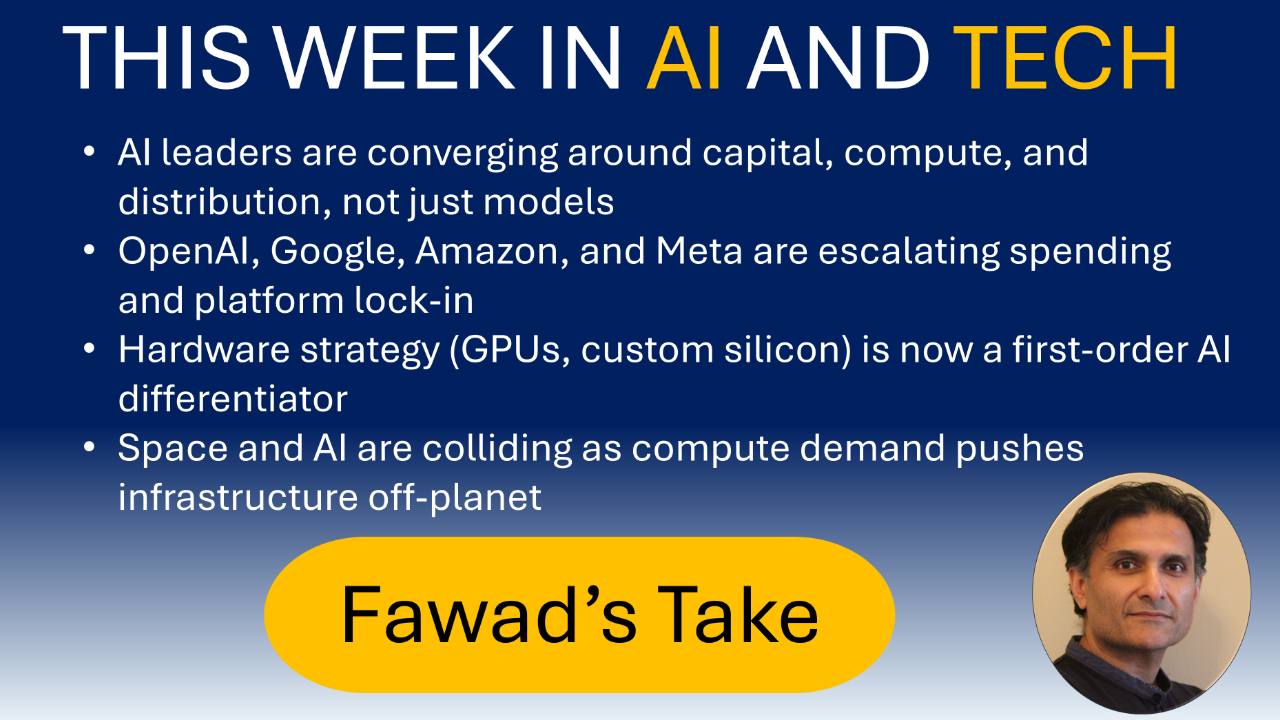
This week highlights how AI has shifted from experimentation to platform execution and infrastructure strategy.
Apple is quietly laying the groundwork for long-term AI relevance by embedding intelligence directly into its operating systems while keeping the underlying models interchangeable. OpenAI continues to push forward through capital and compute scale, while Meta is beginning to see early returns from its aggressive AI investments over the past year.
At the same time, AI tooling is becoming foundational inside enterprises, reshaping how software is built and delivered. Beyond AI, autonomy—from satellite networks to robotaxis and humanoid robots—is advancing rapidly, though real-world deployment remains constrained by cost, safety, and engineering realities.
AI
Apple expands AI across Siri and wearables
Apple is revamping Siri into a deeply embedded AI chatbot across iPhone and Mac, positioning it as a core operating-system capability rather than a standalone assistant. The redesigned Siri will allow Apple to swap underlying models over time, starting with Google-powered systems. In parallel, Apple is also exploring an AirTag-sized AI pin equipped with cameras, microphones, and a speaker, potentially launching as early as 2027—though the project remains early and could be canceled.
Read the full story
OpenAI explores a $50B funding round
OpenAI CEO Sam Altman has been meeting with Middle Eastern investors to explore a funding round that could reach $50 billion. The discussions are still early, but they underscore the growing capital intensity required to build and operate frontier AI systems. OpenAI has also held recent talks with Amazon around additional funding.
Read the full story
Meta’s New AI team delivers early internal models
Meta’s reorganized AI lab has delivered its first major internal models, which leadership says show strong potential. Significant post-training and refinement work remains before broader internal or consumer use, but the results suggest Meta’s heavy AI investments in 2025 are beginning to pay off. The next two years will be critical for translating research progress into products.
Read the full story
Google pushes personalized search with AI mode
Google is expanding its AI-powered Search experience by enabling AI Mode to use private context from Gmail and Photos. The move allows for more personalized results and signals Google’s intent to make search more context-aware, while raising important questions around data usage and privacy boundaries.
Read the full story
Open-Source voice AI advances with Qwen3-TTS
Alibaba’s Qwen team has open-sourced the Qwen3-TTS family of speech generation models. The models support voice cloning, voice design, emotional expression, and natural language-based voice control across 10 major languages and multiple dialects. This release lowers barriers for developers building high-quality voice-first AI experiences.
Read the full story
AI-Assisted coding becomes the Enterprise default
Salesforce reports that over 90% of its 20,000 engineers now use Cursor in their daily workflows. The widespread adoption has improved development speed and code quality and reflects a broader industry shift toward AI-assisted software engineering as a standard practice rather than an experiment.
Read the full story
GitHub brings Agentic AI to any application
GitHub has released the Copilot SDK in technical preview, allowing developers to embed Copilot’s agentic core directly into their own applications. The SDK handles orchestration, tool routing, permissions, and safety boundaries, enabling developers to build agent-based experiences without managing complex AI infrastructure themselves.
Read the full story
Science & Futuristic Technology
Blue Origin enters the Satellite Internet race
Blue Origin plans to deploy more than 5,400 satellites to build a global communications network aimed at enterprise, data center, and government customers. The TeraWave network is expected to deliver data speeds of up to 6 terabits per second, with initial deployments beginning late next year.
Read the full story
Tesla accelerates autonomy across Robotaxis and Humanoid Robots
Tesla has launched public robotaxi rides in Austin without in-vehicle safety monitors for part of its fleet, marking a significant step toward fully autonomous transportation. Separately, Elon Musk says Tesla plans to sell humanoid Optimus robots by the end of 2027. While early progress is visible, major challenges remain around safety, dexterity, manufacturing scale, and reliability.
Read the full story


Responses